

According to the Gospel of John, a Roman soldier pierced the side of Jesus with a spear as he hung on the cross. That spear, usually called the Holy Lance, became one of the most sought-after relics of the Christian world. Today at least four objects in Europe and Armenia have been claimed as the real thing, and in the twentieth century a new legend grew up around one of them: that whoever holds the “Spear of Destiny” holds the fate of the world.
This article looks at what the sources actually say, what is known about each surviving lance, and how the modern legend came about.
Key facts
- Biblical source: John 19:34 is the only Gospel to mention the spear. It does not name the soldier.
- The name Longinus: comes from later, non-biblical writing, especially the apocryphal Gospel of Nicodemus.
- Main claimed relics: Vienna (Imperial Treasury), the Vatican (St Peter’s Basilica), Etchmiadzin (Armenia) and a copy in Kraków (Poland). A lance “found” at Antioch in 1098 has since been lost.
- Best-studied example: the Vienna lance, which scientific study in 2003 dated to around the 7th or 8th century AD.
- “Spear of Destiny”: the occult legend linking the lance to world domination and to Hitler comes mainly from a 1973 book by Trevor Ravenscroft, not from historical records.
The spear in the Gospels and early tradition
John’s Gospel says that the soldiers did not break Jesus’s legs because he was already dead, “but one of the soldiers pierced his side with a spear”. Nothing more is said about the weapon. Over the following centuries Christian writers gave the soldier a name, Longinus, and a story: he was said to have been healed of poor eyesight by the blood and to have become a believer. These details appear in texts such as the Gospel of Nicodemus, which the church never accepted as scripture.
By the 6th century pilgrims to Jerusalem reported seeing a lance displayed in the church on Mount Zion. From there, relics said to be the lance, or parts of it, spread across the Christian world, often split into pieces or passed between rulers as diplomatic gifts.
The lances that survive
Vienna: the lance of the Holy Roman Emperors
The most famous candidate is kept in the Imperial Treasury (Schatzkammer) of the Hofburg palace in Vienna, as part of the regalia of the Holy Roman Empire. It is a Carolingian-style winged spearhead. An iron pin has been set into its blade, said to be a nail from the Crucifixion, and the blade has been bound with wire after breaking.
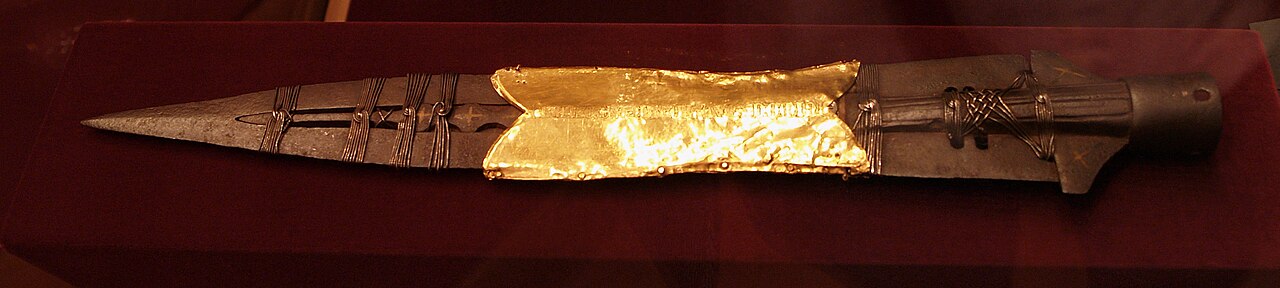
Two sleeves cover the break. The inner silver sleeve is linked to Emperor Henry IV in the late 11th century. The outer gold sleeve was added under Charles IV in the 14th century and carries the inscription Lancea et clavus Domini (“Lance and nail of the Lord”).
In the 10th century the lance was already a symbol of royal power. Chroniclers say Otto I carried it at the Battle of Lechfeld in 955, when he defeated the Magyars. At that time, though, it was often described as the lance of St Maurice, a Roman soldier-saint, rather than the spear of the Crucifixion. Its identification with the lance of Longinus became firm only later.
In 2003 a metallurgist, Robert Feather, was allowed to examine the lance with X-ray and other tests. The results suggested the spearhead was made around the 7th or 8th century AD. The nail could be older, but nothing showed it came from 1st-century Jerusalem. In short, the Vienna lance is a genuine early medieval treasure, but not a weapon from the Crucifixion.
The Vatican lance
A spear tip kept in St Peter’s Basilica in Rome came from Constantinople. In 1492 the Ottoman sultan Bayezid II sent it to Pope Innocent VIII, reportedly as part of an arrangement over the sultan’s brother, who was being held in the West. The Vatican has never claimed it is proven authentic; it is kept as a relic of long tradition. It is displayed only rarely and is housed above the statue of St Longinus by Bernini.
The Antioch lance
During the First Crusade, in 1098, the crusaders were trapped inside Antioch and short of food. A monk named Peter Bartholomew announced that St Andrew had shown him in visions where the Holy Lance was buried. A spearhead was dug up in the cathedral, and the discovery is credited with raising morale before the crusaders broke out and defeated the besieging army.
Many in the crusader army doubted the find. To prove his claim, Peter Bartholomew agreed to an ordeal by fire, walking through flames. He died of his injuries some days later, and supporters and sceptics argued over what this meant. The Antioch lance later disappeared from record.
Etchmiadzin, Armenia
The lance shown at the top of this article is kept at Etchmiadzin, the centre of the Armenian Apostolic Church. Armenian tradition says it was brought to Armenia by the apostle Thaddeus. For centuries it was held at the Geghard monastery, whose name means “spear” in Armenian. It is a spearhead with a cross cut through it, which suggests it was made as a ceremonial or symbolic object rather than as a weapon.
Kraków, Poland
Wawel Cathedral in Kraków holds a copy of the Vienna lance. It is linked to the year 1000, when Emperor Otto III is said to have given a replica of the imperial lance to Bolesław I of Poland. It has always been understood as a copy, and it shows how the lance served as a sign of royal authority.
Hitler and the Vienna lance
After Nazi Germany annexed Austria in 1938, the imperial regalia, including the lance, were moved from Vienna to Nuremberg, the city of the Nazi party rallies. This fitted the regime’s habit of using symbols of the old German empire. At the end of the Second World War, American forces recovered the regalia, which had been hidden in a bunker in Nuremberg. They were returned to Vienna in 1946, where they remain.
These facts are well documented. What is not documented is the idea that Hitler was obsessed with the lance from his youth, believed it would give him power, or that he lost the war because the Americans took it. Those claims belong to the legend described below.
Where the “Spear of Destiny” legend comes from
The name “Spear of Destiny” and the idea that the lance gives its owner the power to shape history are modern. They were spread above all by Trevor Ravenscroft’s book The Spear of Destiny, published in 1973. Ravenscroft claimed that the young Hitler had a mystical experience in front of the lance in Vienna, and he built a long chain of earlier owners who supposedly drew power from it, including Constantine the Great and Charlemagne.
Historians have found no evidence for these claims. Ravenscroft said much of his information came from a man named Walter Stein, who had died before the book was written, and some of it was described as coming from occult or psychic insight. The links to Constantine and Charlemagne do not appear in medieval sources about the lance. Even so, the book was a bestseller and inspired many later books, documentaries and films, which is why the legend is so widely repeated today.
Theories at a glance
- One of the surviving lances is the real spear. No surviving lance has been shown to date from the 1st century, and the best-studied one, in Vienna, is several centuries too young.
- The original was lost and the relics are later stand-ins. This is the most likely explanation. Relics were often made, copied or re-identified in the Middle Ages, sometimes honestly as objects of devotion rather than deliberate fakes.
- The lance gives its owner supernatural power. This idea is modern and rests on Ravenscroft’s book, not on historical evidence.
Our take
The Holy Lance is a good example of how a single line of scripture can grow into a long chain of relics, politics and legends. The Vienna lance is a real and important object: it was carried by medieval emperors, wrapped in silver and gold by later ones, and taken by the Nazis as a trophy. But the evidence points to it being an early medieval spearhead, not the weapon of the Crucifixion, and the claim that it shapes the fate of nations comes from a 1970s bestseller rather than from history. The real story is interesting enough without the myth.
More to explore
- The mystery of the missing Amber Room, another treasure moved by the Nazis during the war.
- How the swastika changed meaning, on the Nazi use of older symbols.
- Prophecies that came true, or didn’t.
Sources and further reading
- The Gospel of John, chapter 19, verse 34.
- Encyclopaedia Britannica, “Holy Lance“.
- Kunsthistorisches Museum Vienna, Imperial Treasury (Kaiserliche Schatzkammer), collection information on the Holy Lance.
- Trevor Ravenscroft, The Spear of Destiny (1973), the main source of the modern legend.