

Every year, thousands of Americans report something strange in the sky. Most turn out to be planes, satellites, balloons, planets or drones. A few become famous, either because many people saw them at once, because pilots or radar picked them up, or because nobody could explain them at the time.
This article looks at seven of the best-known American sightings, in date order. For each one we set out what was reported, what investigators found, and how much of a mystery is really left.
At a glance
- Kenneth Arnold (Washington State, 1947): the sighting that gave us the phrase “flying saucer”.
- The Lubbock Lights (Texas, 1951): a V of lights photographed over a college town.
- The Washington, D.C. radar sightings (1952): unknown blips over the capital, two weekends running.
- The Flatwoods Monster (West Virginia, 1952): a glowing object and a tall figure in the woods.
- The Marfa Lights (Texas, ongoing): mysterious lights seen from the same desert road.
- The Phoenix Lights (Arizona, 1997): lights seen by thousands across a state.
- The “Tic Tac” (Pacific Ocean, 2004): a Navy encounter later released on video by the Pentagon.
1. Kenneth Arnold and the first “flying saucers” (1947)
On 24 June 1947, a businessman and private pilot named Kenneth Arnold was flying near Mount Rainier in Washington State when he saw nine bright objects moving in a line at what he estimated was enormous speed. He later said they moved like a saucer skipping across water.
Newspapers turned that description into “flying saucers”, and within weeks hundreds of similar reports were coming in from across the country. The Roswell story broke in early July the same year. Arnold’s sighting is the reason so many later witnesses described disc-shaped craft, even though Arnold himself said the objects he saw were not round.
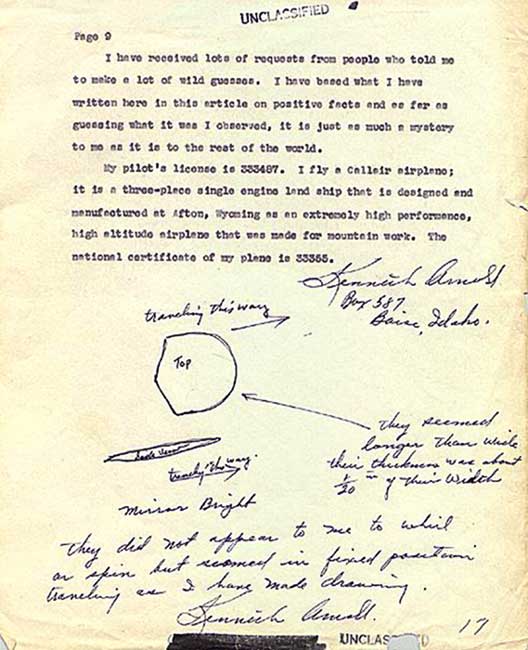
What it probably was: nobody knows for certain. Suggestions include a formation of military jets, sunlight glinting off distant aircraft, and even large birds such as pelicans, which were common in the area. The US Air Force eventually listed it as a mirage. What is certain is its effect: it started the modern UFO era.
2. The Lubbock Lights (1951)
On the evening of 25 August 1951, three professors at Texas Technological College in Lubbock were sitting in a backyard when a loose, curved formation of faint, bluish lights passed silently overhead. They saw it again on several more nights. A few days later, a local student named Carl Hart Jr. photographed a V-shaped group of lights from his bedroom window, and the photos appeared in newspapers across the country.
The US Air Force investigated as part of its early UFO studies. The scientists who saw the lights were trained observers, which made the case harder to dismiss.
What it probably was: the leading explanation, accepted by the Air Force investigator Edward Ruppelt, is migrating birds called plovers, whose pale undersides reflected the city’s new mercury-vapour streetlights. Some witnesses disagreed, and Hart’s photos have never been fully explained, but birds fit most of the evidence.
3. The Washington, D.C. radar sightings (1952)
On two weekends in July 1952 (the 19th–20th and the 26th–27th), radar operators at Washington National Airport and nearby Andrews Air Force Base picked up groups of unidentified targets over the capital. Some pilots in the area reported seeing lights. Fighter jets were sent up to intercept, but the targets seemed to vanish when the jets approached and reappear when they left.
The story made front pages nationwide, and the Air Force held its biggest press conference since the Second World War to respond.
What it probably was: the Air Force said the blips were caused by a temperature inversion, a layer of warm air over cooler air that can bend radar signals and make ground objects appear as moving targets. That was a hot, humid summer, and such inversions were common. Some radar operators were never convinced, but it remains the most widely accepted explanation.
4. The Flatwoods Monster (1952)
On 12 September 1952, a group of boys in the small town of Flatwoods, West Virginia, saw a bright object streak across the sky and appear to land on a nearby hill. They went to look with a local mother and a National Guardsman. At the top, their torch lit up a tall figure with a glowing face and a hood-like shape around its head, which seemed to glide towards them with a hissing sound. They fled, and several later complained of sore throats and nausea.
What it probably was: the investigator Joe Nickell argued that the “object” in the sky was a meteor (one was seen across several states that night), a flashing light on the hill was an aircraft beacon, and the “monster” was a barn owl perched on a branch, with its round face and hooting call, seen in panic and in the dark. The nausea may have been caused by fear and by the smell of the grass. The case has become a piece of local folklore, with a museum in nearby Sutton.
5. The Marfa Lights (ongoing)
Near the small town of Marfa in West Texas, people have reported glowing lights on the horizon for well over a century. They appear to float, split, merge and fade, usually to the southwest of US Route 67, towards the Chinati Mountains. The lights are popular enough that the state built an official viewing area beside the highway.
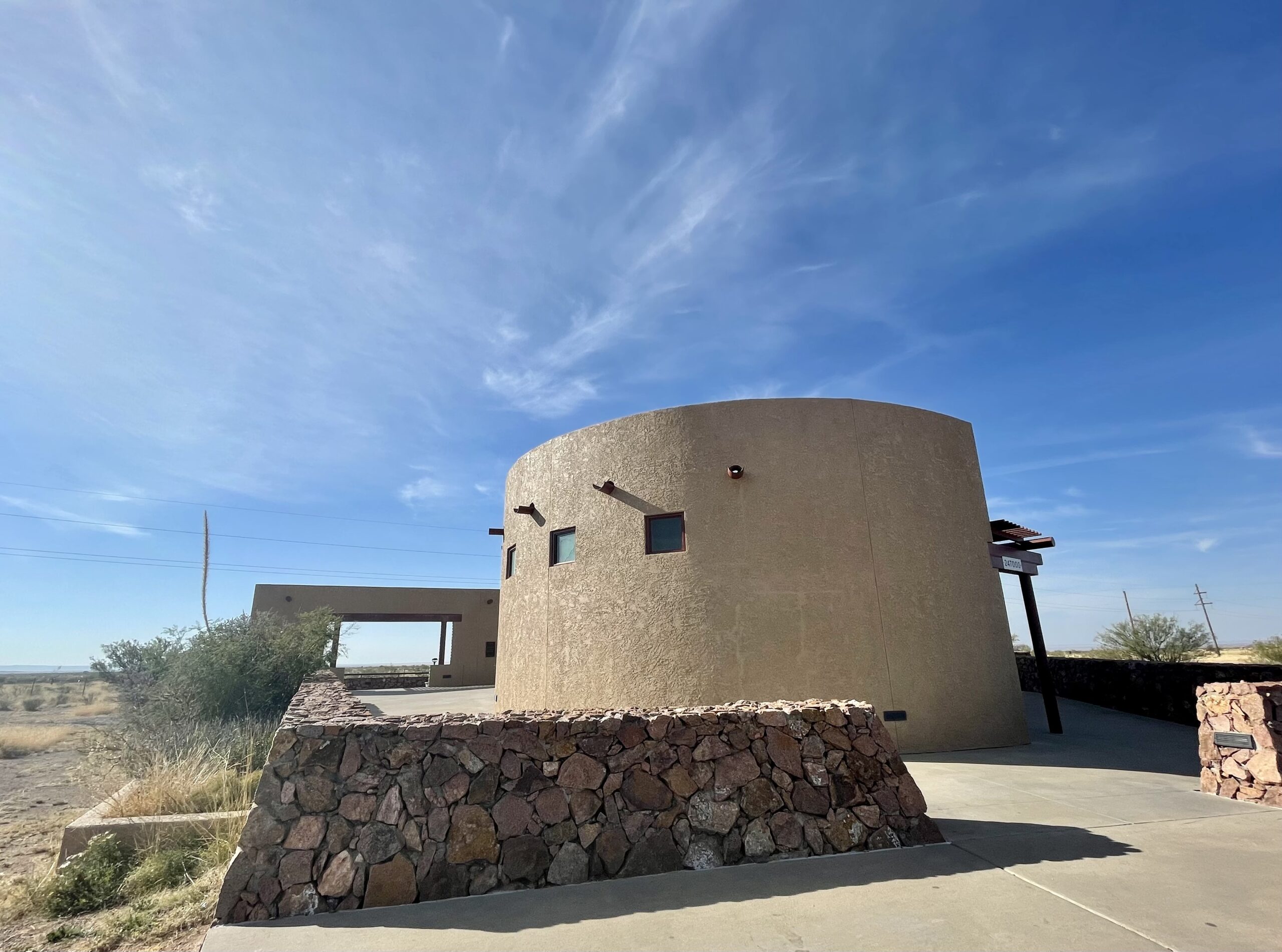
What it probably was: in 2004, a team of physics students from the University of Texas at Dallas watched and recorded the lights over several nights and matched most of them to the headlights of cars on a distant stretch of US 67. Desert air, which forms layers of different temperatures at night, can also bend light and make distant lights shimmer or appear to float. Not every report fits neatly, but most researchers think headlights and atmospheric effects explain the bulk of them.
6. The Phoenix Lights (1997)
On the evening of 13 March 1997, thousands of people across Arizona reported strange lights. It was really two separate events:
- Around 7:30–8:30 pm, people from the Nevada border to Tucson saw a large V-shaped formation of lights moving slowly across the sky. Some said it was a single huge, silent craft that blotted out the stars.
- Around 10 pm, a row of bright, glowing orbs hung over the mountains south of Phoenix and then disappeared one by one. This was filmed by many people.
What it probably was: the later lights were explained by the military: they were flares dropped by A-10 aircraft during a training exercise over the Barry Goldwater Range, and they vanished as they dropped behind the mountains. The earlier V-shape is more debated. Several observers who looked through telescopes said it was a formation of planes flying with their lights on, and an amateur astronomer reported seeing the individual aircraft. Arizona’s governor at the time, Fife Symington, joked about the sighting at a press conference but said years later that he had seen something he couldn’t explain.
7. The “Tic Tac” encounter (2004)
In November 2004, the aircraft carrier group of the USS Nimitz was training off the coast of southern California. For several days, radar operators on the cruiser USS Princeton tracked unknown objects. Navy pilots, including Commander David Fravor, were sent to look. Fravor later said he saw a smooth white object, shaped like a Tic Tac sweet, hovering over the water, which then accelerated away faster than anything he had seen. Another crew filmed an object using their infrared camera.
The video became public in 2017, when the New York Times reported on a secret Pentagon programme that studied such incidents. The Department of Defense formally released it, with two other Navy videos, in 2020.
What it probably was: this one is genuinely unresolved. Sceptics point out that the infrared video on its own is blurry and could show a distant aircraft, and that the camera’s tracking can create the illusion of fast movement. Witnesses say the video is only a small part of what they saw and tracked. No official explanation has been published for this specific incident.
What the official investigations found
The US government has looked into UFO reports several times:
- Project Blue Book (1952–1969): the US Air Force studied 12,618 reports. It explained most of them as aircraft, balloons, stars, planets and hoaxes. 701 remained “unidentified”, usually because there wasn’t enough information, not because there was evidence of anything exotic.
- The Pentagon’s UAP office (AARO, since 2022): in its 2024 report on the history of US government UFO investigations, it found no evidence that any sighting involved alien technology, and no evidence of a hidden alien programme. It does still receive reports it can’t explain, mostly because of poor data.
The term the government now uses is “UAP”, unidentified anomalous phenomena, which deliberately makes no claim about where they come from.
Our take
Look at these seven cases together and a pattern appears. Most were real experiences of real things: birds, flares, meteors, headlights, radar quirks and planes. The mystery came from seeing familiar things in unfamiliar conditions, often at night, with no way to judge size or distance.
That doesn’t make the witnesses foolish, and it doesn’t mean every case is closed. A few, like the “Tic Tac”, still lack a convincing answer. But “unexplained” means “we don’t have enough information”, not “it must be aliens”. The best cases are the ones that teach us how easily our eyes can be fooled.
More to explore
For more on America’s best-known UFO stories, read our articles on the Roswell incident and Area 51. For creature sightings, see the Mothman of Point Pleasant and Bigfoot. And for mysterious lights outside the US, read about the Hessdalen lights in Norway.
Sources and further reading
- All-domain Anomaly Resolution Office (2024). Report on the Historical Record of U.S. Government Involvement with Unidentified Anomalous Phenomena, Volume 1. US Department of Defense.
- US National Archives: Project Blue Book records and fact sheet.
- Ruppelt, E. J. (1956). The Report on Unidentified Flying Objects. Doubleday.
- Nickell, J. (2000). “The Flatwoods UFO Monster”. Skeptical Inquirer, 24(6).
- US Department of Defense (2020). Statement on the release of historical Navy videos.
- Wikipedia overviews of each case, which link to the original press reports.