

Every few months a headline announces that someone “predicted” a disaster, an election or a pandemic years in advance. Prophecy fascinates us because it promises that the future can be known. Some predictions really did turn out to be remarkably close to the mark. Many more failed completely, and others were written after the event. Here are some of the most famous cases, what really happened, and why we remember the hits and forget the misses.
Predictions that came surprisingly close
The novel that “predicted” the Titanic
In 1898, 14 years before the Titanic sank, the American writer Morgan Robertson published a novella called Futility. It describes a huge British liner called the Titan, said to be unsinkable, that strikes an iceberg in the North Atlantic in April and sinks with heavy loss of life because there aren’t enough lifeboats. The similarities are striking. But they are not mysterious. Liners were getting bigger, icebergs were a known danger on the North Atlantic route in spring, and writers were already warning that lifeboat rules hadn’t kept up with ship sizes. Robertson, a former sailor, was making an educated guess about a real risk.
Mark Twain and Halley’s Comet
Mark Twain was born in 1835, shortly after Halley’s Comet appeared. In 1909 he reportedly said that he came in with the comet and expected to go out with it. He died on 21 April 1910, one day after the comet’s next closest approach to the Sun. It’s a genuinely eerie coincidence, but Twain was 74 and already seriously ill with heart disease when he made the remark.
Jules Verne’s moon shot
In From the Earth to the Moon (1865) and its sequel, Jules Verne described three men launched to the Moon from Florida in an aluminium capsule. After their journey, the capsule splashes down in the Pacific Ocean. A century later, Apollo 8 and Apollo 11 did much the same. Verne got the physics of his giant cannon badly wrong, but he based his story on careful calculations of the real problem.
A forecast for the year 2000
In 1900 the engineer John Elfreth Watkins wrote an article for the Ladies’ Home Journal called “What May Happen in the Next Hundred Years”. He correctly foresaw:
- colour photographs sent around the world by “telegraph”;
- wireless telephones connecting continents;
- ready-cooked meals delivered to homes.
He also predicted that the letters C, X and Q would be dropped from the alphabet, and that mosquitoes would be wiped out. Like most good forecasters, he got some things right by thinking carefully about where technology was heading, and plenty wrong.
Famous prophets, examined
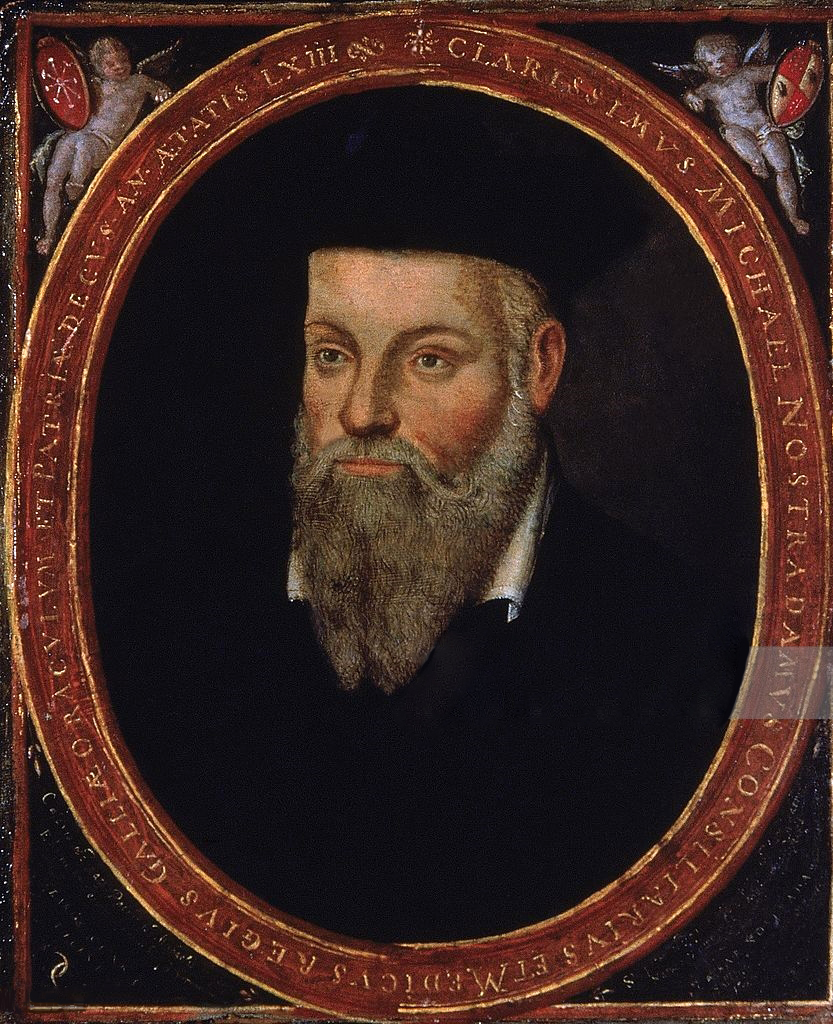
Nostradamus
Michel de Nostredame (1503–1566) was a French physician and astrologer. In 1555 he published Les Prophéties, a book of four-line verses called quatrains. Written in a mix of French, Latin and obscure references, with almost no dates, they can be made to fit almost anything after the fact. His most famous “hit” is a verse that mentions “Hister”, often read as Hitler. But Hister was the classical Latin name for the lower Danube river. When Nostradamus did give a specific date, the “great king of terror” falling from the sky in July 1999, nothing happened.
Baba Vanga
Vangeliya Gushterova (1911–1996), a blind Bulgarian mystic known as Baba Vanga, is credited online with predicting 9/11, the 2004 tsunami and much else. She left no written prophecies, and most of the predictions attributed to her appeared only after the events they supposedly foretell. Some widely shared “quotes” have been shown to be invented. Meanwhile, the specific predictions credited to her, such as a third world war beginning in 2010, did not come true.
The Simpsons
The cartoon is often said to have “predicted” events such as Donald Trump’s presidency, mentioned as a joke in a 2000 episode. With over 750 episodes packed with jokes about current affairs, some are bound to match later events. Several viral examples have also turned out to be edited images or scenes from after the event.
Predictions that failed
- The Great Disappointment (1844): followers of the American preacher William Miller sold their possessions, expecting the Second Coming on 22 October 1844. Nothing happened.
- Harold Camping (2011): the US radio broadcaster spent heavily on billboards announcing that the Rapture would begin on 21 May 2011. When it didn’t, he moved the date to October. That passed too.
- The Maya “end of the world” (2012): 21 December 2012 marked the end of a cycle in the Maya Long Count calendar, not a prediction of doom. The apocalypse was a modern invention.
- Psychic flops: the American psychic Sylvia Browne told the mother of a missing teenager in Ohio on television in 2004 that her daughter was dead. The young woman was found alive in 2013.
- Y2K: the millennium computer bug wasn’t a prophecy but a real technical problem. Disaster was avoided largely because programmers spent years fixing it beforehand.
Why prophecies seem to come true
- Vagueness: a prediction with no dates or names can be matched to many events.
- Hindsight: predictions are often “found” or reinterpreted only after something happens.
- Numbers: with millions of predictions made every year, some will match by chance. We remember those and forget the rest.
- Expertise: some “prophecies”, like Robertson’s or Watkins’s, were simply well-informed forecasts.
When the Australian skeptic Richard Saunders led a project that checked thousands of psychic predictions published in Australian media between 2000 and 2020, only about one in ten turned out to be correct. Many of the hits were things that were obvious or likely anyway.
Our take
The future can sometimes be anticipated, but by people who understand trends, risks and technology, not by people claiming mystical sight. A good test for any prophecy: was it written down before the event, was it specific, and how many other predictions by the same person failed? Almost none of the famous ones pass all three.
More to explore
For more on why our minds fall for compelling stories, read about the psychology of conspiracy theories. Or try a theory that rewrites the calendar itself: the phantom time hypothesis.
Sources and further reading
- Robertson, M. (1898). Futility, or the Wreck of the Titan.
- Watkins, J. E. (1900). “What May Happen in the Next Hundred Years.” Ladies’ Home Journal, December 1900.
- Randi, J. (1990). The Mask of Nostradamus. Charles Scribner’s Sons.
- Britannica: 10 failed doomsday predictions.
- Skeptical Inquirer: Failed psychic predictions.