
Every night, you spend around two hours in a world your brain makes up. You fly, fall, get chased, turn up to an exam you never studied for, or talk to people who died years ago. Then you wake up and forget almost all of it.
Why do we dream at all? And do dreams actually mean anything? Scientists have studied these questions in sleep labs for more than 70 years. This article sets out what they have found, what is still debated, and where popular ideas about dreams go wrong.
The short answer
- Everyone dreams, every night, even people who say they never do.
- The most vivid dreams happen during REM sleep, a stage when the brain is very active and the body is temporarily paralysed.
- Nobody knows for certain why we dream. The leading ideas are that dreams help process memories and emotions, rehearse responses to threats, or are partly a side-effect of the brain’s night-time activity.
- Dreams often reflect your worries, experiences and relationships. But there’s no scientific support for dream dictionaries that give fixed meanings to symbols.
How dreaming was discovered in the lab
In 1953, at the University of Chicago, a student named Eugene Aserinsky and his supervisor Nathaniel Kleitman noticed that sleepers’ eyes darted rapidly under their closed eyelids at regular periods during the night. When they woke people up during these periods, the sleepers usually reported vivid dreams. They called this stage rapid eye movement (REM) sleep.
We now know a night’s sleep is made up of cycles lasting roughly 90 minutes. Each cycle moves from light sleep into deep sleep and then into REM. The REM periods get longer towards morning, which is why the dreams you remember are usually from just before you wake.
During REM sleep:
- Brain activity looks surprisingly like being awake, especially in areas linked to vision, movement and emotion.
- The areas linked to logic and self-control are quieter, which may be why dreams feel normal while you’re in them, however bizarre they are.
- Most of your muscles are paralysed, which stops you acting out your dreams.
Dreams also happen outside REM, but they tend to be shorter, less vivid and more like ordinary thoughts.
The main theories of why we dream
Freud: dreams as hidden wishes
In The Interpretation of Dreams (1899), Sigmund Freud argued that dreams are disguised expressions of unconscious wishes, often sexual or aggressive, and that analysing their symbols could reveal hidden desires. His ideas were hugely influential in culture, but they were never tested scientifically in a way that held up, and most modern sleep researchers don’t accept them.
Activation-synthesis: the brain making sense of noise
In 1977, the Harvard psychiatrists J. Allan Hobson and Robert McCarley proposed that during REM sleep, the brainstem fires off fairly random signals, and the rest of the brain does its best to weave them into a story. On this view, dreams are a by-product, not a message. Hobson later refined the theory, accepting that dreams also reflect our memories and emotions.
Memory processing
Sleep plays an important role in learning. Experiments show that people remember new skills and facts better after sleeping, and that the brain “replays” recent experiences during sleep. In rats that have run a maze, researchers have recorded the same patterns of brain-cell activity repeating while they sleep. Dreams may be the conscious tip of this process, mixing new memories with old ones.
Emotional processing
Many researchers think REM sleep helps us handle emotional experiences. Stress chemicals in the brain are low during REM, which may allow us to revisit upsetting memories more safely. This could explain why so many dreams are emotional, and why sleep problems are closely linked to anxiety and depression.
Threat simulation
The Finnish psychologist Antti Revonsuo suggested in 2000 that dreams evolved as a kind of rehearsal: a safe space to practise escaping danger. That would explain why being chased or attacked is one of the most common dream themes around the world.
These theories aren’t necessarily rivals. Dreams may do several jobs at once, or be partly useful and partly a side-effect.
Why do we forget our dreams?
Most dreams are forgotten within minutes of waking. Researchers think this is because the brain chemistry during REM, especially low levels of noradrenaline, makes it hard to store new memories. Unless you wake up during or right after a dream and think about it, it usually slips away.
This is why people who keep a dream diary by the bed, and write in it immediately on waking, quickly start remembering more dreams.
Common dreams and what they might mean
Surveys in many countries find the same themes coming up again and again:
- Being chased or attacked
- Falling
- Being late, or failing an exam
- Teeth falling out
- Flying
- Being naked in public
- A dead relative still being alive
Researchers mostly see these as reflecting common human worries, such as fear of failure, embarrassment or loss, rather than coded symbols. Dreams tend to borrow from your current concerns. If you’re stressed about work, you’re more likely to dream about work, in some distorted form.
So a dream can tell you something about how you’re feeling. But the idea that “teeth falling out means money troubles” or “a snake means betrayal” comes from dream dictionaries, which aren’t based on evidence. The same image can mean very different things to different people.
Nightmares and sleep paralysis
Almost everyone has nightmares sometimes, especially children. Frequent nightmares are linked to stress, trauma, some medications and poor sleep. A therapy called imagery rehearsal, in which people rewrite a recurring nightmare while awake, has good evidence for reducing them.
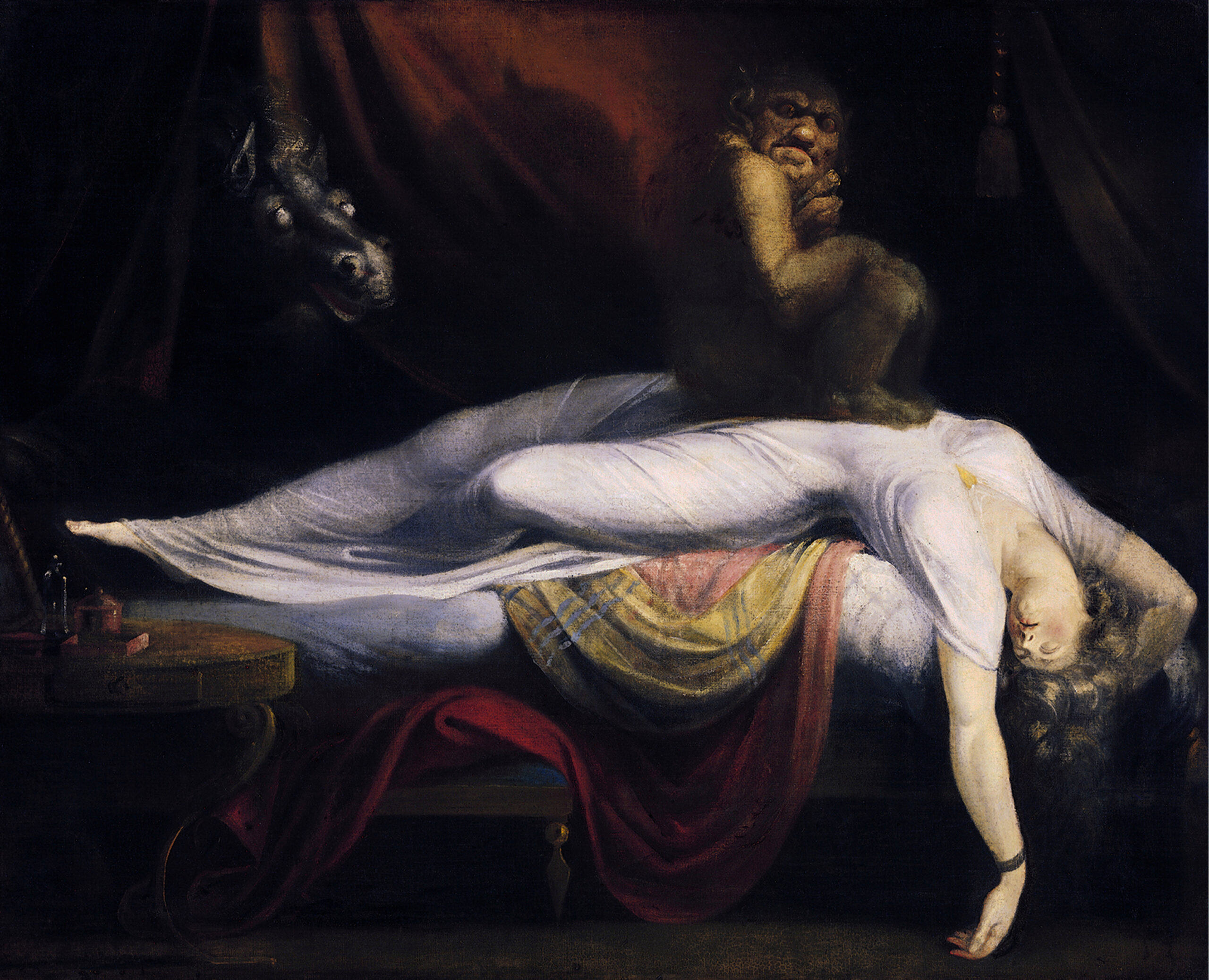
A related experience is sleep paralysis: waking up while the body is still in REM paralysis. People can’t move, often feel pressure on their chest, and may “see” a figure in the room. It’s frightening but harmless, and it may explain many historical accounts of night demons, like the creature in Fuseli’s famous painting above, as well as some modern “alien abduction” and ghost stories.
Lucid dreaming
A lucid dream is one where you realise you’re dreaming, and sometimes take control of what happens. In the late 1970s and early 1980s, researchers including Keith Hearne in Britain and Stephen LaBerge at Stanford proved lucid dreams were real by having dreamers send pre-agreed signals with their eyes during REM sleep, which showed up on the lab’s recordings.
In 2021, teams in several countries even managed simple two-way communication with lucid dreamers, asking them maths questions that they answered with eye movements while still asleep. About half of people say they’ve had at least one lucid dream.
A few more surprising facts
- Blind people dream. People blind from birth don’t have visual dreams, but they dream in sound, touch, smell and emotion.
- Animals probably dream. Many mammals and birds have REM sleep, and the “replay” seen in sleeping rats suggests something dream-like.
- Not all dreams are in colour. Some studies found older people, who grew up with black-and-white TV, report more black-and-white dreams than younger people.
Our take
Dreams are neither secret messages from the unconscious nor random nonsense. The best evidence suggests they’re the brain’s night-time processing of memory and emotion, filtered through a mind that has temporarily switched off its usual logic. That makes them a useful mirror of what’s on your mind, but not a code to be cracked with a dictionary.
There’s still a lot we don’t know, including the biggest question of all: why the sleeping brain produces conscious experiences in the first place. That makes dreaming one of the most interesting open problems in brain science.
More to explore
For other open questions about the mind, read the mysteries of the human brain. If you’re interested in claims about dreams predicting the future, see our article on psychics and famous prophecies.
Sources and further reading
- Aserinsky, E. & Kleitman, N. (1953). “Regularly occurring periods of eye motility, and concomitant phenomena, during sleep”. Science, 118(3062).
- Hobson, J. A. & McCarley, R. W. (1977). “The brain as a dream state generator: an activation-synthesis hypothesis of the dream process”. American Journal of Psychiatry, 134(12).
- Revonsuo, A. (2000). “The reinterpretation of dreams: an evolutionary hypothesis of the function of dreaming”. Behavioral and Brain Sciences, 23(6).
- Konkoly, K. R. et al. (2021). “Real-time dialogue between experimenters and dreamers during REM sleep”. Current Biology, 31(7).
- Walker, M. (2017). Why We Sleep. Scribner. A readable overview (some of its wider health claims have been criticised).