

Few symbols have had a stranger history than the swastika. For thousands of years it was a sign of good fortune across Asia, Europe and beyond. It appeared on temple walls, Roman mosaics, Christmas cards and Coca-Cola souvenirs. Then, in 1920, the Nazi Party adopted it, and in the West it became the emblem of one of the darkest regimes in history. Today it is sacred to over a billion people and banned in some countries. Here is how that happened.
Key facts
- Name: from Sanskrit svastika, from su (“good”) and asti (“it is”), roughly meaning “conducive to well-being”.
- Age: swastika designs appear on objects thousands of years old across Eurasia, including seals from the Indus Valley Civilisation around 2500 BCE.
- Religious use: a sacred symbol in Hinduism, Buddhism and Jainism to this day.
- Nazi adoption: the Nazi Party adopted a tilted black swastika as its emblem in 1920, calling it the Hakenkreuz (“hooked cross”).
- Today: Nazi use of the symbol is a criminal offence in Germany and several other countries, with exceptions for religious, educational and artistic use.
An ancient and widespread sign
The swastika is a simple shape: a cross with arms bent at right angles. Its simplicity may explain why it appears in so many places. Meander and swastika-like patterns appear on prehistoric objects in Europe. Clear swastikas appear on seals from the Indus Valley Civilisation in what is now Pakistan and India. Later they turn up on:
- ancient Greek pottery and coins;
- Celtic and Anglo-Saxon metalwork;
- Byzantine buildings;
- Native American basketry and textiles, especially among the Navajo and Hopi.
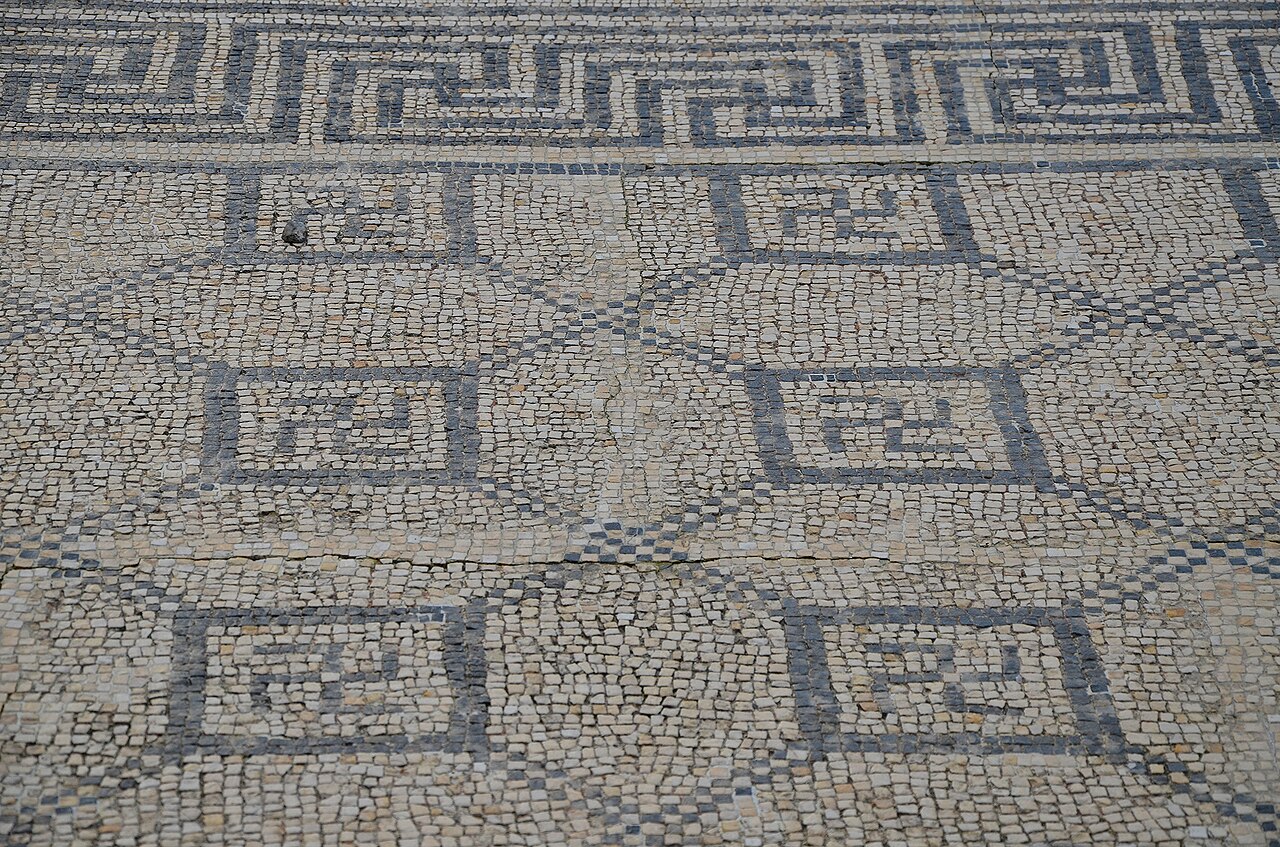
Roman builders used repeating swastika patterns in floor mosaics across the empire, from Britain to Portugal.
A sacred symbol in Asia
In Hinduism, the swastika represents good fortune and is linked with the god Ganesha and the goddess Lakshmi. It is painted on doorways, account books, wedding invitations and vehicles, especially during the festival of Diwali. In Jainism it is one of the most important symbols. Its four arms represent the four possible states of rebirth. In Buddhism it often marks the Buddha’s footprints or chest. In East Asia it is known as manji in Japanese and wan in Chinese, and it is used on maps in Japan to mark Buddhist temples. For hundreds of millions of people, this has always been its only meaning.
A Western craze for a “lucky” symbol
In the late 19th century, the swastika became fashionable in Europe and North America as a good-luck charm. Part of the reason was archaeology. In the 1870s Heinrich Schliemann found many swastikas while excavating the site of ancient Troy in Turkey, and some scholars linked the symbol to a supposed ancient “Aryan” people. Soon it appeared everywhere:
- The Danish brewer Carlsberg used it on its buildings and labels.
- Rudyard Kipling’s books carried a swastika on their covers until the 1930s.
- Coca-Cola produced a swastika-shaped lucky charm.
- Scout movements in Britain and the United States used it on badges for years.
- The Finnish Air Force used a blue swastika as its insignia from 1918 to 1945. This had no connection with the Nazis.
The Nazi takeover of the symbol
At the same time, German nationalist and racist groups took up the swastika as a sign of supposed “Aryan” racial origins. The Nazi Party adopted it in 1920, designing a black swastika in a white circle on a red background, and Hitler described the design in Mein Kampf. After the Nazis took power in 1933, it became part of the German national flag in 1935.
The symbol appeared on everything from uniforms and buildings to the banners of mass rallies. To the victims of the Holocaust, to the soldiers who fought Nazi Germany and to the generations since, it became the emblem of genocide, war and racial hatred. Western companies and organisations that had used it quickly dropped it during the 1930s.
The swastika today
After 1945 the Nazi use of the swastika was banned in Germany, where displaying it is still a criminal offence. There are exceptions for education, art, research and reporting. Austria has similar laws. In 2007 Germany proposed an EU-wide ban on Nazi symbols. The idea was dropped, partly after Hindu groups objected that it would affect their religious symbol. More recently, several Australian states have banned the display of Nazi symbols, with explicit exemptions for Hindu, Buddhist and Jain use. Finland’s Air Force Academy quietly removed swastika imagery from its emblem in 2020.
Some Hindu, Buddhist and Jain communities in the West have campaigned to separate their sacred swastika from the Nazi Hakenkreuz. They argue that the word and the symbol were taken from them. Holocaust survivors and Jewish organisations, for their part, point out that for many people the symbol still causes deep pain. Both points are valid, and in the West the debate is ongoing.
Myths and misconceptions
- “The Nazi swastika faces the opposite way, so it’s a different symbol.” Both left- and right-facing swastikas appear in religious use. The Nazi version is typically right-facing and tilted 45 degrees, but direction alone doesn’t define its meaning.
- “Any swastika in Asia is a sign of Nazi sympathy.” No. In India, Nepal, Japan and elsewhere, it’s an everyday religious symbol with no connection to Nazism.
- “The RAF used the swastika on its planes.” This is a common online claim but not true. It’s probably a confusion with the Finnish Air Force.
Our take
The swastika shows that a symbol’s meaning isn’t fixed in its shape. It comes from how people use it. In a few years the Nazis turned a sign of well-being into a sign of terror for much of the world. For a large part of humanity, though, the original meaning never changed. Understanding both histories is the only way to make sense of the symbol today.
More to explore
For more on how ideas and beliefs spread, read about the psychology of conspiracy theories, or step back in time with the carved symbols of Göbekli Tepe.
Sources and further reading
- United States Holocaust Memorial Museum: History of the Swastika.
- Smithsonian Magazine: How the swastika, an ancient symbol of good fortune, became the Nazi logo.
- BBC News: article on attempts to rehabilitate the swastika (2014).
- Heller, S. (2000). The Swastika: Symbol Beyond Redemption? Allworth Press.