

On the night of 15 August 1977, the Big Ear radio telescope in Ohio, USA, picked up a strong, narrow radio signal from deep space. It lasted 72 seconds. A few days later, the volunteer astronomer Jerry Ehman was checking the computer printouts when he spotted it. He circled the code “6EQUJ5” in red pen and wrote “Wow!” in the margin.
The name stuck. Nearly 50 years later, the Wow! signal is still the most famous possible alien signal ever recorded, and it has never been detected again. Here’s what was actually picked up, why it caused excitement, and what scientists now think it might have been.
Key facts
- Date: 15 August 1977, at about 10:16 pm local time.
- Telescope: Big Ear, Ohio State University’s radio observatory near Delaware, Ohio, as part of a search for extraterrestrial intelligence (SETI).
- Duration: 72 seconds, the full time the telescope could observe any one point in the sky.
- Frequency: very close to 1420 MHz, the natural radio frequency of hydrogen.
- Direction: the constellation Sagittarius.
- Repeated? No, despite many searches.
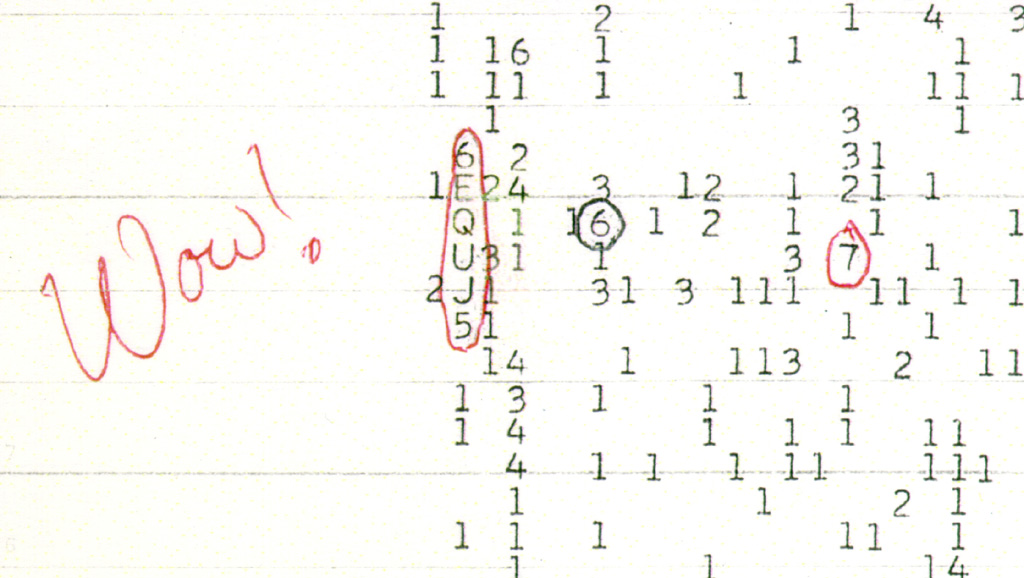
What does “6EQUJ5” mean?
It isn’t a message. It’s a record of how strong the signal was. Big Ear’s computer printed the strength of radio signals as a single character every 12 seconds: numbers 1 to 9 for weak signals, then letters for stronger ones, with A meaning 10 and so on. Most of the printout shows spaces and 1s, meaning background noise.
“6EQUJ5” shows the signal rising and falling over 72 seconds. The peak, “U”, meant it was about 30 times stronger than the background noise.
Why it looked so promising
Several features made the signal stand out:
- The frequency. 1420 MHz is the frequency at which hydrogen, the most common element in the universe, naturally gives off radio waves. Scientists had long suggested that aliens trying to contact us might choose it, since any technological civilisation would know about it. It’s also a protected frequency, so Earth transmitters aren’t allowed to use it.
- A narrow signal. It was concentrated in a single narrow frequency channel. Natural sources usually spread over a wide range, while radio transmitters use narrow bands.
- The right shape. Big Ear didn’t move. It relied on the Earth’s rotation to sweep across the sky. A real point in space would drift through the telescope’s view, rising and falling over 72 seconds. That’s exactly the pattern the signal showed, which suggests it came from space rather than from Earth.
Why it’s still a puzzle
Big Ear had two feed horns pointing at slightly different parts of the sky. A source in space should have been picked up by one horn, then by the other a few minutes later. The Wow! signal appeared only once. Either it switched off within minutes, or something else was going on. Unfortunately, the way the data was recorded means we can’t tell which horn picked it up.
Then there’s the bigger problem: it never came back. Ehman and colleagues watched the same spot many times in the following months. Others later searched with larger telescopes, including the Very Large Array in New Mexico in the 1990s. None of them found anything.

The main explanations
1. An alien transmission
This is what made the signal famous. If an alien civilisation swept a powerful beam across space, like a lighthouse, we might catch it only once. But a single, unrepeated detection is not enough evidence. Even Ehman remained cautious and said that too little could be concluded from too little data.
2. Interference from Earth or a satellite
A signal from Earth, reflected off space debris or a satellite, could in theory produce a false detection. But the 1420 MHz band is protected, and the signal’s shape matched something moving across the sky with the stars. No convincing human source has been found.
3. Comets
In 2016–17, the researcher Antonio Paris suggested the signal came from hydrogen clouds around two comets that were in that area of the sky in 1977. Most astronomers rejected this. Comets don’t give off strong, narrow signals at this frequency, and the comets weren’t in the right positions.
4. A natural flare in a hydrogen cloud
The most recent idea comes from a team led by Abel Méndez of the University of Puerto Rico at Arecibo, who reviewed old data from the Arecibo telescope. In 2024 they reported finding similar but much fainter narrow signals from cold hydrogen clouds. They suggested the Wow! signal might have been a rare, sudden brightening of one such cloud, triggered by a burst of energy from a powerful star such as a magnetar. It’s an interesting explanation, but it hasn’t been proven yet and is still being studied.
What happened to Big Ear?
The Big Ear telescope ran one of the longest SETI projects in history, from 1973 to 1995. It was demolished in 1998, and the land became part of a golf course. The printout with Ehman’s famous circle has survived.
Our take
The Wow! signal was real: something produced a strong, narrow radio burst at hydrogen’s frequency, from somewhere in space. But one 72-second event that never came back can’t tell us what it was. A rare natural process is the most likely answer, and the hydrogen cloud idea is promising. Whatever it turns out to be, the signal shows why scientists keep listening, and why they need repeated, confirmed detections before claiming anything extraordinary.
More to explore
Read about other things in the sky that scientists still argue about, such as the Hessdalen lights in Norway, or see our list of unsolved mysteries.
Sources and further reading
- Ehman, J. R. (1997, updated 2010). “The Big Ear Wow! Signal: What We Know and Don’t Know About It After 20 Years”. Big Ear Radio Observatory.
- Gray, R. H. (2012). The Elusive Wow: Searching for Extraterrestrial Intelligence. Palmer Square Press.
- Méndez, A. et al. (2024). “Arecibo Wow! I: An Astrophysical Explanation for the Wow! Signal”. Preprint, arXiv.
- SETI Institute: seti.org.