

Bigfoot, also called Sasquatch, is said to be a huge, hairy, upright ape living in the forests of North America, especially the Pacific Northwest. Thousands of people have reported seeing one. There are footprint casts, blurry photos and one famous film. Yet after more than 65 years of searching, there is still no body, no bone and no confirmed DNA. This article looks at where the legend came from, the best-known evidence, and what science has found when it tested that evidence.
Key facts
- Also known as: Sasquatch, from a word in Halkomelem, a Coast Salish language of British Columbia.
- Usual description: 2–3 m tall, covered in dark hair, walking on two legs, with large footprints up to about 40 cm long.
- Where: sightings come from almost every US state and Canadian province, but most often from the Pacific Northwest.
- The name “Bigfoot”: first used in a California newspaper in 1958.
- Most famous evidence: the Patterson–Gimlin film, shot at Bluff Creek, California, in 1967.
- Physical proof: none confirmed. Every “Bigfoot” hair tested has come from a known animal.
Where the legend came from
Many Indigenous peoples of North America have traditions of wild, hairy giants of the forest, with different names and meanings from nation to nation. In the 1920s and 1930s a schoolteacher in British Columbia, J. W. Burns, collected some of these stories and popularised the word “Sasquatch”.
The modern Bigfoot was born in 1958. At a road-building site at Bluff Creek in northern California, a bulldozer operator found enormous human-like footprints and made a plaster cast. The Humboldt Times ran the story, the workers’ nickname “Bigfoot” stuck, and the story went national. In 2002, after the death of the construction company owner Ray Wallace, his family said he had made the tracks as a prank using carved wooden feet, and they showed the press a pair of them. Some Bigfoot researchers dispute this, but it seriously damaged the case that started it all.
The Patterson–Gimlin film
On 20 October 1967, Roger Patterson and Bob Gimlin were riding along Bluff Creek when, they said, they saw a female Bigfoot by the water. Patterson filmed about a minute of shaky 16 mm footage of a dark, hairy figure walking away and turning to look at the camera. It is still the most famous image of Bigfoot.
Supporters argue that the figure’s proportions, muscle movement and walk would have been very hard to fake in 1967. Sceptics say it looks like a person in a costume, and that the film’s speed, which affects how natural the walk looks, cannot be known for certain. In 2004 a man named Bob Heironimus claimed he had worn the suit, and a costume maker said he had sold the suit to Patterson. Gimlin has always maintained it was real. More than fifty years later, the film has been neither proved nor disproved, which is itself telling: a real animal would have been filmed far better since.
What the science says
DNA tests
In 2014 the Oxford geneticist Bryan Sykes and colleagues published the most careful study so far. They asked researchers and enthusiasts around the world to send in hair said to come from Bigfoot, the Yeti and similar creatures, and analysed 30 samples. Every one came from a known animal, including bears, wolves, cows, horses, raccoons, deer, a porcupine and humans. Two Himalayan samples first seemed to match an ancient polar bear, but a later re-analysis matched them to ordinary Himalayan brown bears.
An earlier claim, from a Texas team led by the veterinarian Melba Ketchum, said Bigfoot was a human-ape hybrid. It was published in 2013 in a new online journal that had no other papers. Geneticists who looked at the data said it showed a mix of human DNA, probably from contamination, and DNA from other animals.
The black bear connection
A 2009 study by Jeffrey Lozier and colleagues mapped Bigfoot sightings in the western United States and compared them with the habitats of known animals. The pattern of sightings matched the range of the American black bear very closely. Black bears sometimes stand and walk short distances on their hind legs, and in poor light, at a distance and with no sense of scale, a standing bear can look surprisingly like an ape.
Gigantopithecus
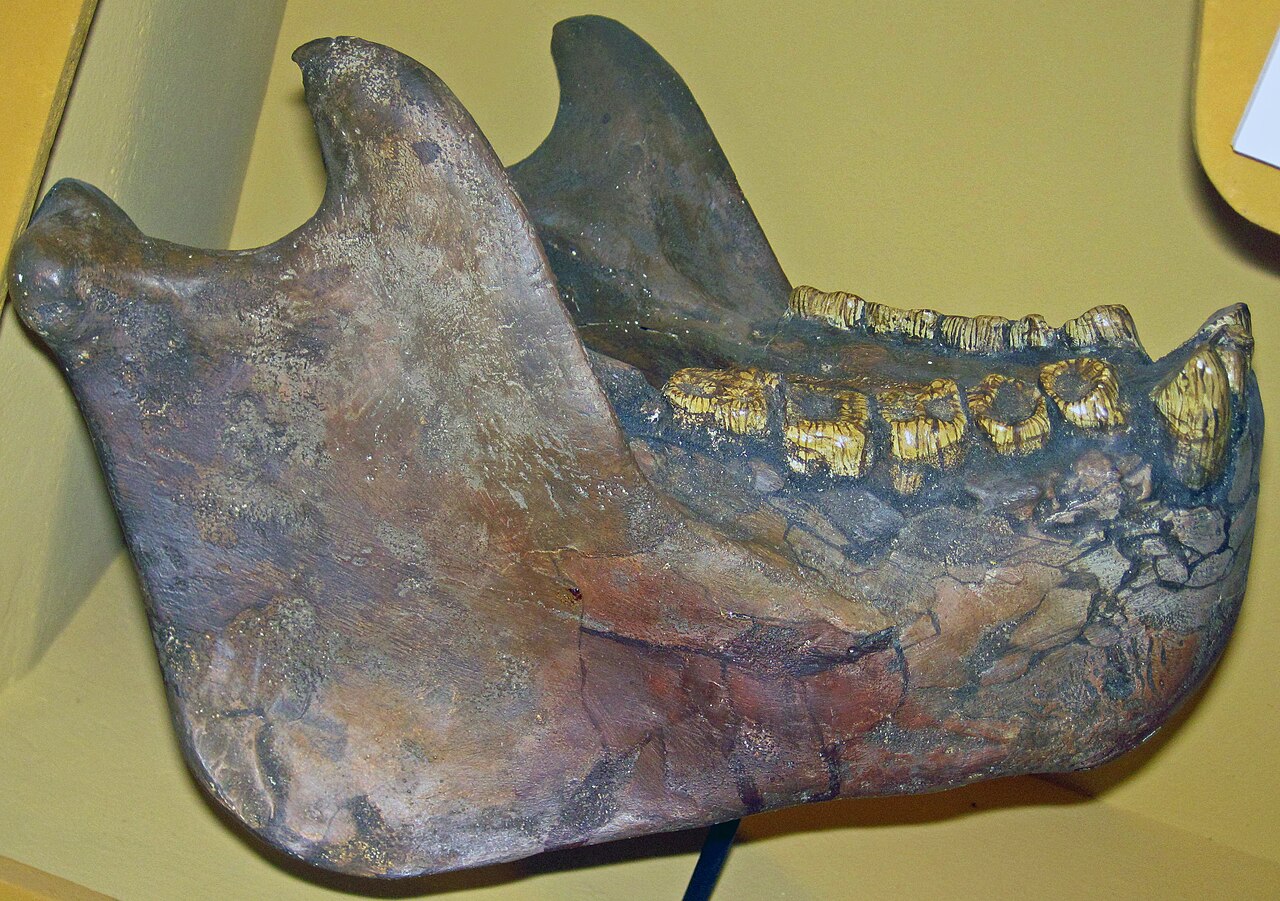
Bigfoot enthusiasts often point to Gigantopithecus, a real giant ape that may have stood up to 3 m tall. But it lived in southern China and South-East Asia, is known only from teeth and jaws, and most likely moved on all fours. A 2024 study in Nature dated its extinction to between about 295,000 and 215,000 years ago. There is no fossil evidence that it, or any other ape, ever reached the Americas.
Why scientists are unconvinced
- No bodies. For a species to survive, there must be a breeding population of at least hundreds of animals. Yet no Bigfoot has ever been found dead, hit by a car, shot by a hunter or caught on a wildlife camera, even though cameras catch rare animals such as wolverines every year.
- Cameras everywhere. Almost everyone now carries a high-quality camera, but Bigfoot photos have not got any clearer.
- Hoaxes. Fake footprints, costumes and stunts are common. In 2008 two men in Georgia claimed to have a frozen Bigfoot body. It turned out to be a rubber gorilla suit.
- Footprints vary. Casts differ widely in size, shape and number of toes, more like the work of many people than one species.
The anthropologist David Daegling, who studied the evidence closely, concluded that the case rests on stories and impressions that cannot be tested, not on the kind of physical proof that settles questions in biology.
Our take
Bigfoot almost certainly isn’t real as a living ape. The evidence that started the modern legend was probably a prank, the famous film can’t be verified, DNA tests keep finding bears, and the forests of North America are too well explored for a large animal population to leave no bones. What is real is the experience: people do see something in the woods, usually a bear, in conditions that make it hard to judge. Bigfoot is best seen as an American folk legend, and a good one.
More to explore
Read about Scotland’s equivalent legend, the Loch Ness Monster, or browse our list of unsolved mysteries.
Sources and further reading
- Sykes, B. C. et al. (2014). “Genetic analysis of hair samples attributed to yeti, bigfoot and other anomalous primates.” Proceedings of the Royal Society B.
- Lozier, J. D., Aniello, P. & Hickerson, M. J. (2009). “Predicting the distribution of Sasquatch in western North America: anything goes with ecological niche modelling.” Journal of Biogeography.
- Zhang, Y. et al. (2024). “The demise of the giant ape Gigantopithecus blacki.” Nature.
- Daegling, D. J. (2004). Bigfoot Exposed: An Anthropologist Examines America’s Enduring Legend. AltaMira Press.
- Loxton, D. & Prothero, D. R. (2013). Abominable Science! Columbia University Press.