

In February 1959 nine young, experienced hikers died on a snowy mountain slope in the northern Ural Mountains of the Soviet Union. Their tent was found cut open from the inside, and most of them had fled into temperatures far below freezing without boots or proper clothes. Some bodies had severe injuries. For decades the case fed theories about secret weapons, yetis and UFOs. Today a scientific explanation is widely accepted, though not by everyone.
Key facts
- When: the night of 1–2 February 1959.
- Where: the eastern slope of Kholat Syakhl (“Dead Mountain” in the local Mansi language), northern Urals. The nearby pass is now named after the group’s leader.
- Who: nine members of a ski-touring group, mostly students and graduates of the Ural Polytechnic Institute, led by 23-year-old Igor Dyatlov. A tenth member, Yuri Yudin, turned back ill early in the trip and survived.
- Main cause of death: hypothermia for six; serious injuries for three.
- 1959 verdict: death by “a compelling natural force”.
- 2020 Russian review: an avalanche combined with poor visibility.
The expedition
The group set out in late January 1959 to reach Otorten, a mountain in the northern Urals, on a route graded as the most difficult category for Soviet ski tourism. All were experienced hikers and skiers. On 1 February they stopped for the night on an open slope of Kholat Syakhl, rather than descending to the shelter of the forest below. They dug a platform into the snow and pitched their large tent. Photos and diaries found later show they were in good spirits.
What the searchers found
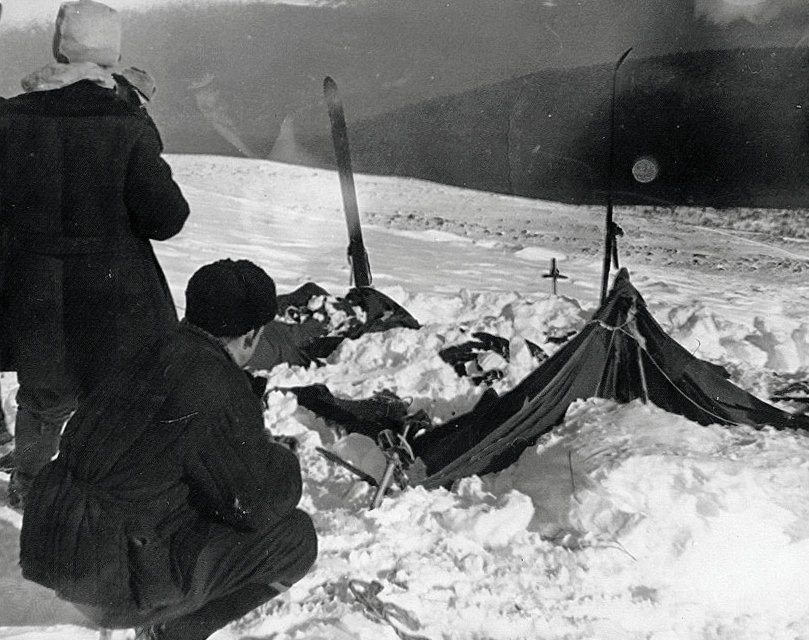
When the group did not return, search teams set out. On 26 February they found the tent half-collapsed and covered with snow. It had been cut open from the inside. Inside were boots, coats, food and equipment. Footprints of eight or nine people led downhill towards the forest about 1.5 km away. The prints showed people walking, not running, many of them in socks or barefoot.
- At the forest edge: two men were found by the remains of a small fire under a large cedar tree, wearing only underwear. Branches had been broken from the tree up to several metres high.
- On the slope: three more bodies, including Dyatlov’s, lay between the cedar and the tent, in positions suggesting they were trying to get back. One had a small skull fracture.
- In May: when the snow melted, the last four were found in a ravine in the forest, under several metres of snow. They were wearing clothes taken from the others. Two had severe chest fractures and one had a serious skull injury, but with little damage to the skin. One woman was missing her tongue and eyes.
Explaining the strange details
Several of the most-quoted “mysteries” have ordinary explanations:
- Undressing: people dying of hypothermia often take off their clothes, a known effect called “paradoxical undressing”. Others took clothes from the dead to survive.
- Missing tongue and eyes: the bodies in the ravine lay in a stream for months. Soft tissue is the first to decay and is eaten by small scavengers.
- Radiation: some clothing showed low-level radioactive traces. One of the group had worked at the Mayak nuclear plant, where a serious accident (the Kyshtym disaster) happened in 1957, which could explain contamination.
- Orange lights in the sky: other groups in the region reported glowing spheres in February and March 1959. These match the timing of Soviet missile test launches.
The theories
Over the years, the deaths have been blamed on:
- Military tests such as parachute mines or rocket debris. There is no record of tests in that area at that time, and no blast damage was found.
- An attack by local Mansi people. This was investigated and dismissed in 1959. The Mansi had no reason to attack, and there were no other footprints.
- Infrasound, low-frequency sound from wind that might cause panic. It is possible, but untested.
- Yetis, UFOs and other creatures. These have no evidence.
The avalanche explanation
In 2019 Russian prosecutors reopened the case and in 2020 concluded that an avalanche, followed by poor visibility, forced the group to leave the tent. Many people doubted this. The slope is not very steep, there were no obvious avalanche tracks, and the group had left the tent in an orderly way.
In 2021 two Swiss-based scientists, Johan Gaume and Alexander Puzrin, published a study in Communications Earth & Environment that answered many of those objections. Their model showed that:
- by cutting into the slope to build their tent platform, the hikers weakened the snow above them;
- strong winds blew more snow onto the slope over the following hours, adding weight;
- a relatively small slab of snow, a few metres across, could then break off and fall onto the tent, delayed until the middle of the night.
To test the injuries, they used data from car crash tests and computer simulation methods also used for animated snow in films. A heavy slab falling on people lying on their skis on the tent floor could cause the kind of chest and skull fractures found, without much damage to the skin. A small slab would leave few traces weeks later, especially after fresh snow.
On this explanation, the group cut their way out in a panic, fearing a bigger avalanche, and headed for the shelter of the forest, planning to come back. In the dark, wind and cold, they could not find the tent again. The injured were probably hurt in the tent, while the others died of exposure trying to survive.
Our take
The Dyatlov Pass incident is less mysterious than its reputation. The 2021 slab avalanche model explains the cut tent, the orderly retreat and the worst injuries, and the other strange details have natural explanations. Some questions about that night will never be answered, since nobody survived to tell the story. What is clear is that nine brave and capable young people were caught out by a small, unexpected disaster in one of the harshest places on Earth.
More to explore
Read our round-up of strange disappearances that remain unsolved, or our list of unsolved mysteries.
Sources and further reading
- Gaume, J. & Puzrin, A. M. (2021). “Mechanisms of slab avalanche release and impact in the Dyatlov Pass incident in 1959.” Communications Earth & Environment.
- Eichar, D. (2013). Dead Mountain: The Untold True Story of the Dyatlov Pass Incident. Chronicle Books.
- McCloskey, K. (2013). Mountain of the Dead: The Dyatlov Pass Incident. The History Press.